
You’re not imagining it. There’s a measurable cost you’re paying that your colleagues don’t even know exists.
You’ve done everything right.
You earned the degrees. You exceeded the targets. You stayed late, showed up early, and delivered results that should have spoken for themselves.
And yet.
You watched your colleague, the one who joined after you, the one whose work you’ve quietly corrected more than once, get the promotion you’d been positioning yourself for. Again.
You’re exhausted by Wednesday. Not physically exhausted, mentally drained in a way you can’t quite explain to anyone who hasn’t lived it. Your husband thinks you’re overworked. Your manager thinks you’re doing fine. You’re starting to wonder if the problem is you.
It’s not.
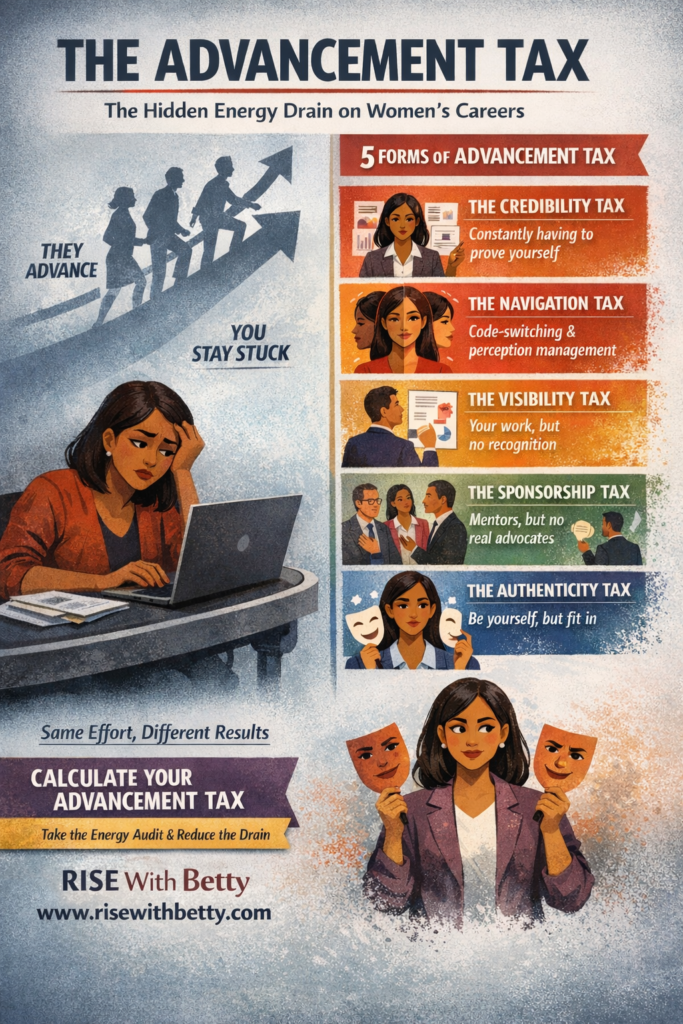
What you’re experiencing has a name. I call it the Advancement Tax; it’s the invisible reason talented women stay stuck while watching less qualified colleagues advance.
What Is the Advancement Tax?
The Advancement Tax is the invisible energy drain you pay simply to exist in professional spaces that weren’t designed for you.
It’s the 30-40% of your mental capacity that goes toward navigating dynamics your colleagues don’t think twice about: proving your competence repeatedly, managing how you’re perceived, calculating how to phrase feedback so it lands without backlash, code-switching between your authentic self and your “professional” self, watching your ideas get questioned while his get implemented.
This concept builds on research by Catalyst, which documented what they call the “Emotional Tax”: the burden of being constantly on guard against bias, discrimination, and the need to manage perceptions at work. Their research found that nearly 60% of women of colour experience this burden daily.
But here’s what the research doesn’t fully address: this invisible burden has a direct career cost.
While you’re spending 30-40% of your energy on navigation, perception management, and proving yourself, your colleagues are investing that same energy in strategic positioning, relationship building, and advancement activities.
Same work hours. Different focus. They advance. You stay stuck.
That’s the Advancement Tax.
The 5 Forms of Advancement Tax
The Advancement Tax isn’t one thing, it’s five distinct energy drains operating simultaneously. Understanding which ones you’re paying most is the first step to reducing them.
1. The Credibility Tax
Having to prove yourself repeatedly while colleagues get the benefit of the doubt. Every meeting, every project, every idea; you’re starting from zero while they start from “trusted.” You’ve delivered consistently for years, but somehow you’re still being asked to “demonstrate” your capability for opportunities that others are simply offered.
2. The Navigation Tax
Mental exhaustion from code-switching and managing perceptions. You’re constantly calculating: How should I say this? How will this be received? Is this outfit right? Am I being “too much” or “not enough”? This tax is why you’re exhausted by Wednesday; you’re doing two jobs simultaneously: your actual work and the invisible work of managing how your actual work is perceived.
3. The Visibility Tax
Excellent work that nobody sees, or worse, gets attributed to someone else. You deliver results, but somehow you’re invisible when it matters. Your ideas get questioned in the meeting, then praised when someone else repeats them. Your contributions get absorbed into “team efforts”, while his get individual recognition.
4. The Sponsorship Tax
Collecting mentors who advise, but no sponsors who advocate. You have plenty of people who will give you feedback, tell you what to improve, share their wisdom. But no one is putting your name forward in rooms you’re not in. No one is spending their political capital on your advancement. You’re over-mentored and under-sponsored.
5. The Authenticity Tax
Managing impossible contradictions: “Be yourself, but fit in.” “Speak up, but don’t be aggressive.” “Show ambition, but don’t be threatening.” “Be confident, but don’t be arrogant.” The energy spent navigating these double-binds is exhausting, and it’s energy your colleagues never have to spend.
Why “Work Harder” Doesn’t Work
The advice you’ve been given, be more confident, lean in, find a mentor, work on your executive presence, isn’t wrong. It’s incomplete.
This advice assumes a level playing field. It assumes that if you just do more, try harder, and position yourself better, the results will follow.
But you’re not playing on a level field. You’re playing while paying a 30-40% tax that your colleagues don’t pay. The same strategies cost you more. The same hours produce less visible output. The same confidence gets read differently.
Working harder within a broken system doesn’t fix the system, it just exhausts you faster.
What you need isn’t more effort. What you need is strategy that accounts for the tax.
The Path Forward
The first step to reducing your Advancement Tax is recognizing it exists.
Not as a vague feeling of unfairness. Not as imposter syndrome or lack of confidence. But as a measurable, identifiable drain on your career energy that you can systematically reduce.
You can’t eliminate the tax entirely, not while the systems remain unchanged. But you can reduce it significantly. You can identify exactly where your energy is going and redirect it strategically. You can stop paying 40% when you could be paying 15%.
And that difference, that 25% of reclaimed mental energy, is often the difference between staying stuck and finally advancing.
You’ve done everything right. Now it’s time to do something different.
CALCULATE YOUR ADVANCEMENT TAX
Take the free Energy Audit to discover exactly where your mental energy is going, and receive your personalised reduction roadmap.
In just 5 minutes, you’ll:
• Identify your specific Advancement Tax rate
• Discover which of the 5 taxes you’re paying most
• Receive personalized guidance on your next steps
TAKE THE FREE ENERGY AUDIT
Step Inside RISE™
Career transitions rarely fail for lack of effort. They stall when one thing is missing. Inside RISE is built on the C.A.R.E. Framework™ — the four domains that decide whether your transition succeeds by design, or stalls by default:
Clarity — name exactly who you're becoming, so the search stops feeling scattered.
Architecture — the habits, learning, and routines that hold the change up.
Resources — the energy, wellbeing, and relationships to sustain the climb.
Execution — turn the plan into visible, weekly progress instead of good intentions.
Your diagnostics, the RISE Report, the C.A.R.E. Assessment, and the 90-Day Transition Runway — all in one place. Free, and yours to keep.
Where is your career transition stalling?
Are you struggling to map your next career move, or are you having trouble identifying the right executive advocates to back your transition?
Click here to email me directly and share your context; I read and respond to every message personally.