
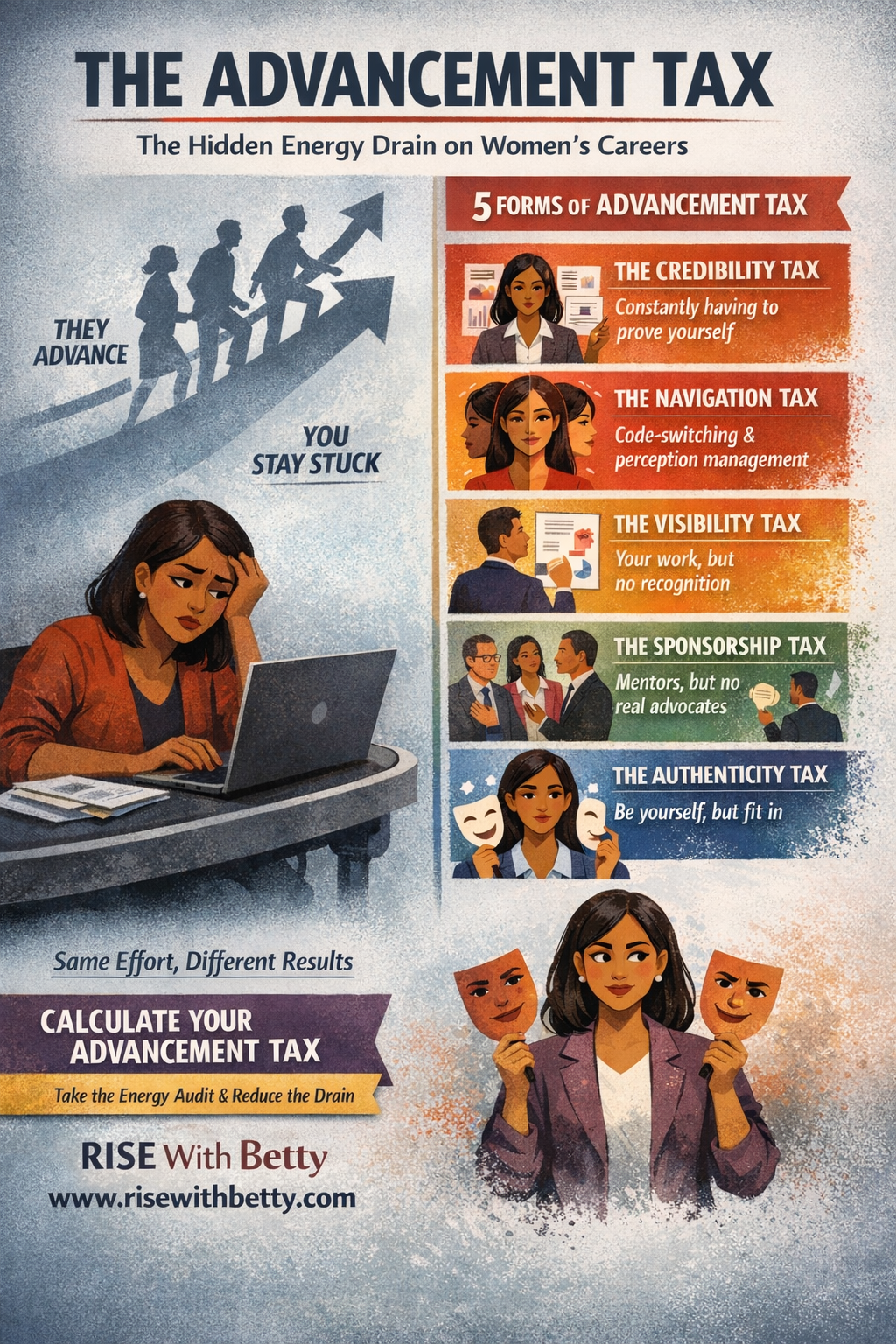
Understanding which taxes you’re paying most helps you target your reduction strategy.
When I introduce the concept of the Advancement Tax, the invisible energy drain that keeps talented women stuck while colleagues advance, I often see immediate recognition.
“Yes. That’s exactly what I’ve been feeling.”
But recognition is just the first step. To actually reduce your tax, you need to understand specifically where your energy is going.
The Advancement Tax isn’t one thing. It’s five distinct categories of invisible labour, each draining your mental capacity in different ways, each requiring different reduction strategies.
Let me walk you through each one, including the signs you’re paying it, the career cost, and what strategic reduction looks like.
Tax #1: The Credibility Tax
“I have to prove myself repeatedly while he gets the benefit of the doubt.”
What It Looks Like
The Credibility Tax is the burden of re-establishing your competence in every new interaction, project, or meeting. While some colleagues walk into rooms with assumed expertise, you walk in needing to demonstrate yours—again.
You’ve delivered consistently for years, but you’re still being asked to “prove” you can handle the next opportunity. Your track record doesn’t compound; each new situation resets you to zero.
Signs You’re Paying It
- Your ideas get scrutinized while others’ get accepted at face value
- You over-prepare for every presentation because you can’t afford a single mistake
- You’re asked to “demonstrate capability” for roles you’re already qualified for
- New team members question your authority until you’ve “proven” yourself to them
- Your credentials get questioned in ways others’ don’t
The Career Cost
The energy spent re-proving yourself is energy not spent on strategic positioning. While you’re building the case for why you deserve the opportunity, others are already capitalising on theirs. The Credibility Tax creates a perpetual lag; you’re always demonstrating capability for the role you should already be in.
Strategic Reduction
Document and socialise your wins systematically. Build a portfolio of evidence that works for you when you’re not in the room. Cultivate sponsors (not just mentors) who will vouch for your credibility in spaces you don’t have access to. Stop over-preparing for every interaction, and strategic under-preparation for low-stakes situations preserves energy for when it matters.
Tax #2: The Navigation Tax
“I’m constantly calculating how things will land before I say anything.”
What It Looks Like
The Navigation Tax is the mental exhaustion of code-switching, perception management, and constant self-monitoring. It’s the running calculation in your head: How should I phrase this? What will they think? Am I being too direct? Not direct enough? Too emotional? Too cold?
This is the tax that makes you exhausted by Wednesday even when your workload is manageable. You’re doing two jobs: your actual work and the invisible work of managing how your work is perceived.
Signs You’re Paying It
- You mentally rehearse conversations before having them
- You modify your communication style depending on who you’re talking to
- You think carefully about what to wear, how to sit, how to present yourself
- You feel like you’re performing a version of yourself rather than being yourself
- You’re drained after meetings even when nothing difficult happened
The Career Cost
The Navigation Tax is perhaps the most insidious because it operates constantly. The cumulative drain of monitoring, modifying, and managing leaves little energy for strategic thinking, creative problem-solving, or relationship building. You’re surviving, not thriving.
Strategic Reduction
Identify your “tax-free zones”: people and contexts where you don’t have to perform. Invest in those relationships. Build templates and scripts for recurring high-navigation situations so you’re not expending fresh energy each time. Choose strategic authenticity, be intentional about where you code-switch and where you don’t, rather than defaulting to constant navigation.
Tax #3: The Visibility Tax
“My work is excellent. It’s just invisible.”
What It Looks Like
The Visibility Tax is the phenomenon of excellent work that goes unnoticed, unrecognized, or attributed to someone else. Your contributions get absorbed into “team efforts.” Your ideas get questioned in the meeting, then praised when someone else repeats them. You’re doing the work, but you’re not getting the credit.
Signs You’re Paying It
- Your accomplishments are known to your immediate team but not beyond
- You’ve seen your ideas credited to someone else
- Senior leaders don’t know your name or contributions
- Your work gets categorized as “support” even when it’s strategic
- You’re the go-to person for getting things done but not for high-visibility opportunities
The Career Cost
Promotions go to people who are known, not just people who deliver. The Visibility Tax means your track record doesn’t speak for you because decision-makers don’t know it exists. You’re building a portfolio that no one with power ever sees.
Strategic Reduction
Strategic visibility is not bragging; it’s ensuring your work reaches the people who need to know about it. Create regular touchpoints with senior leaders. Volunteer for visible projects, not just valuable ones. Build relationships with connectors who amplify others’ work. Document your contributions in places that persist (project retrospectives, quarterly reports, shared documents).
Tax #4: The Sponsorship Tax
“I have mentors. I don’t have anyone opening doors.”
What It Looks Like
The Sponsorship Tax is the gap between advice and advocacy. You have mentors who tell you what to do, but no sponsors who use their political capital to create opportunities for you. You’re collecting feedback but not access.
Research from the Center for Talent Innovation shows that sponsors, not mentors, are the number one predictor of career advancement. Yet women consistently report having plenty of mentors and few sponsors.
Signs You’re Paying It
- You have people who give you advice but no one fighting for your advancement
- Opportunities come through formal applications, not informal recommendations
- You hear about opportunities after they’ve been filled
- No one is putting your name forward in rooms you’re not in
- Your performance reviews are strong but your advancement is slow
The Career Cost
Most significant career opportunities never get posted. They’re decided in informal conversations, leadership meetings, and closed-door discussions. Without sponsors in those rooms, you’re competing only for the opportunities that make it to formal channels, a fraction of what’s actually available.
Strategic Reduction
Convert mentors to sponsors by making sponsorship easy: be specific about what you want, deliver results that make them look good, keep them informed of your wins. Identify potential sponsors (people with power, access, and a track record of advocating for others) and build relationships intentionally. Make your aspirations known, sponsors can’t advocate for opportunities you haven’t expressed interest in.
Tax #5: The Authenticity Tax
“I’m told to be myself and fit in at the same time.”
What It Looks Like
The Authenticity Tax is the energy spent navigating impossible contradictions. Be confident but not arrogant. Speak up but don’t be aggressive. Be ambitious but not threatening. Be yourself but fit in.
These double-binds create an exhausting calculation: constantly trying to find the narrow band of behavior that’s simultaneously assertive enough and not too assertive, confident enough and not too confident, ambitious enough and not too ambitious.
Signs You’re Paying It
- You’ve received contradictory feedback (“speak up more” and “be less aggressive”)
- You feel like you’re walking a tightrope in how you present yourself
- You’ve been penalized for behavior that’s praised in others
- You hold back parts of yourself at work because you’re not sure they’ll be accepted
- You’re exhausted by the performance of professionalism
The Career Cost
The Authenticity Tax creates a ceiling on your impact. When you’re constantly modulating yourself, you can’t bring your full perspective, creativity, or insight to your work. You’re operating at 60-70% of your capacity because the rest is going toward the performance.
Strategic Reduction
Strategic authenticity means being intentional about where you invest energy in conforming and where you don’t. Identify your non-negotiables, the aspects of your authentic self that you won’t compromise, and find environments and relationships where those are valued. Build a reputation for a consistent set of strengths rather than trying to be all things to all people.
Which Taxes Are You Paying Most?
Most professional women pay all five taxes to some degree. But the distribution varies.
Maybe you’ve solved the visibility problem but the credibility tax is killing you. Maybe you’ve got sponsors but the navigation tax is draining your energy before you can capitalize on opportunities.
The path forward isn’t trying to reduce all five taxes simultaneously. It’s identifying which 1-2 are costing you the most and targeting those strategically.
That’s where the work begins.
IDENTIFY YOUR TAX PROFILE
The Energy Audit breaks down exactly which of the 5 Advancement Taxes you’re paying most, so you can target your reduction strategy where it will have the biggest impact.
TAKE THE FREE ENERGY AUDIT
Step Inside RISE™
Career transitions rarely fail for lack of effort. They stall when one thing is missing. Inside RISE is built on the C.A.R.E. Framework™ — the four domains that decide whether your transition succeeds by design, or stalls by default:
Clarity — name exactly who you're becoming, so the search stops feeling scattered.
Architecture — the habits, learning, and routines that hold the change up.
Resources — the energy, wellbeing, and relationships to sustain the climb.
Execution — turn the plan into visible, weekly progress instead of good intentions.
Your diagnostics, the RISE Report, the C.A.R.E. Assessment, and the 90-Day Transition Runway — all in one place. Free, and yours to keep.
Where is your career transition stalling?
Are you struggling to map your next career move, or are you having trouble identifying the right executive advocates to back your transition?
Click here to email me directly and share your context; I read and respond to every message personally.