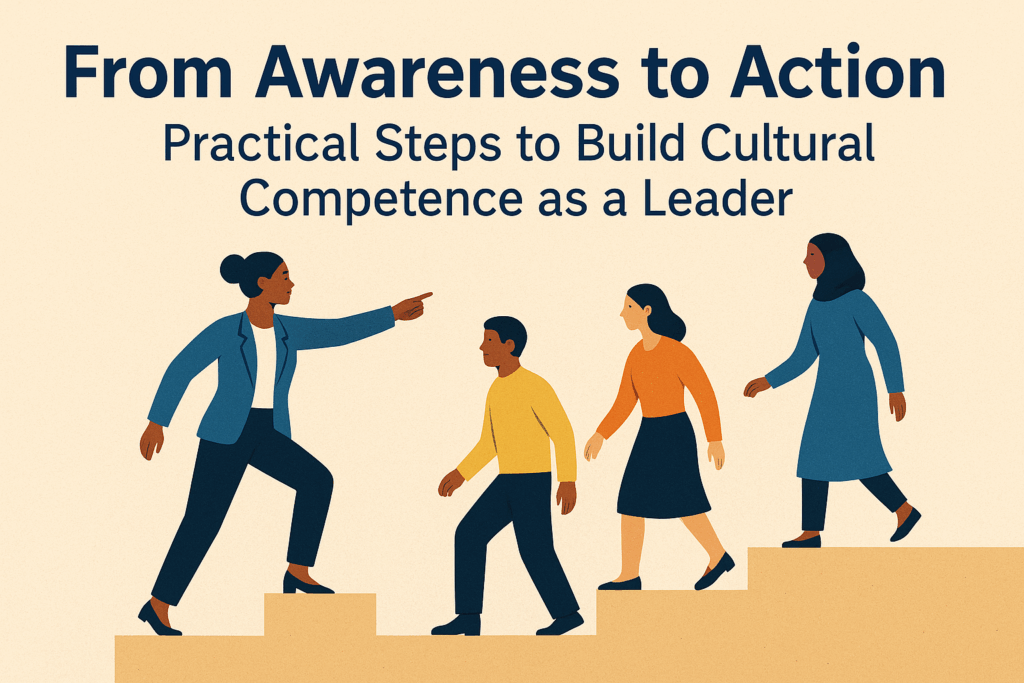
🌍 Awareness Is Just the BeginningLet’s be honest, most of us think we’re culturally aware.We’ve attended the diversity sessions, read the articles, maybe even taken an assessment or two. But awareness alone doesn’t change how people feel in our teams or how decisions are made.Real impact happens when awareness meets action.Cultural competence isn’t about memorizing…
🔍 Step 1: Recognize Your Own Cultural Lens
Every one of us has a cultural story—a mix of upbringing, values, and experiences that shapes how we see the world.
That story influences how we define things like respect, leadership, or teamwork.
Take a quiet moment and ask yourself:
- What values guide how I lead?
- How do those values show up in how I make decisions or give feedback?
- Whose voices do I tend to hear most in my team meetings—and whose might be missing?
When you start noticing your own cultural filters, you gain the clarity to lead more consciously.
Self-awareness is where transformation begins.
🧭 Step 2: Interpret Differences with Curiosity
Have you ever misread someone’s behavior at work?
Maybe a colleague’s silence felt like disinterest—but in their culture, it might mean deep respect or careful thought.
As leaders, it’s easy to interpret behaviors through our own lens. The culturally intelligent approach is to pause and ask:
“Is there another way to understand this?”
Here’s how you can build that habit:
- Ask open questions during conversations.
- Pay attention to how people communicate, not just what they say.
- Expose yourself to global perspectives—books, podcasts, or stories from different cultures.
Curiosity replaces judgment. And that shift opens the door to trust.
⚙️ Step 3: Strategize for Inclusion
Awareness is reflection.
Curiosity is understanding.
Action is where inclusion begins.
Inclusion doesn’t have to mean grand gestures or company-wide campaigns. Often, it’s the small, deliberate choices that shape belonging every day.
Try these:
- Rotate who leads team meetings.
- Ask for input in different ways—some people express best in writing.
- Review your materials, examples, and visuals for cultural bias.
- Make mentoring across cultures part of your leadership rhythm.
When inclusion becomes part of your everyday strategy, your team feels it—and your results will show it.
🚀 Step 4: Elevate Through Continuous Learning
Cultural competence isn’t a milestone you reach—it’s a journey you commit to.
The world keeps changing, and so do cultural norms, languages, and experiences.
Keep learning by:
- Attending inclusive leadership events or webinars.
- Engaging with Employee Resource Groups (ERGs) and listening more than speaking.
- Asking your team, “How can I support you better?”—and acting on what you hear.
Growth in this area isn’t about perfection—it’s about progress.
💡 The RISE Framework: Turning Awareness into Action
At RISE with Betty, I guide women leaders through a simple but powerful model:
R – Recognize: your cultural identity, stories, and blind spots.
I – Interpret: cultural dynamics with curiosity, not judgment.
S – Strategize: take deliberate, inclusive action every day.
E – Elevate: grow into a leader who inspires and empowers across cultures.
Each step helps you rise higher—not by fitting in, but by leading from authenticity.
💬 Final Thought
Cultural competence isn’t just a leadership skill.
It’s a human skill.
When you lead with awareness, empathy, and intention, you create spaces where everyone can contribute—and thrive.
So, this week, try this small challenge:
Choose one way to move from awareness to action.
Maybe it’s listening differently, asking a new kind of question, or giving someone’s perspective a little more room.
Because that’s how change begins—one aware, courageous action at a time
Step Inside RISE™
Career transitions rarely fail for lack of effort. They stall when one thing is missing. Inside RISE is built on the C.A.R.E. Framework™ — the four domains that decide whether your transition succeeds by design, or stalls by default:
Clarity — name exactly who you're becoming, so the search stops feeling scattered.
Architecture — the habits, learning, and routines that hold the change up.
Resources — the energy, wellbeing, and relationships to sustain the climb.
Execution — turn the plan into visible, weekly progress instead of good intentions.
Your diagnostics, the RISE Report, the C.A.R.E. Assessment, and the 90-Day Transition Runway — all in one place. Free, and yours to keep.
Where is your career transition stalling?
Are you struggling to map your next career move, or are you having trouble identifying the right executive advocates to back your transition?
Click here to email me directly and share your context; I read and respond to every message personally.