
You got what you wanted.
Then you started wondering whether you still wanted it.
Not immediately. After the celebration. After the recognition. After the realization that achieving the goal hadn’t answered the question beneath it.
I’ve seen this moment repeatedly among accomplished women.
They think they’re losing motivation.
What they’re actually experiencing is something else: A shift in season.
What that feeling actually is
We are handed one story about career change. One brave leap, somewhere around forty, from the work you fell into toward the work you were meant for. Cross the threshold, and you’re done.
It’s a tidy story, and it quietly tells you that if you’re not making a single clean, cinematic leap, you must be doing it wrong.
Here is the truer version. A career doesn’t move in a straight line, and it was never meant to. The neat, age-stepped staircase we inherited; explore, establish, maintain, decline, was drawn very largely from men’s more linear working lives (Super, 1980; Levinson, 1978), and it has set the silent standard ever since.
But when researchers actually studied women’s careers on their own terms, they found something closer to a kaleidoscope than a ladder: the whole pattern rearranges as different parts of a life take the lead (Mainiero & Sullivan, 2005). Not a climb. A reconfiguring.
Which means the restlessness you can’t explain is usually two ordinary things happening at once. And the moment you can see them, they stop feeling like a verdict on your character.
Two things are true at once
The first is where you are in your life – your season.
The years of building and proving. The years your work is wound up with a partner and a shared life. The heavy, full years of caregiving. The years you look up and ask is this still me. The years you begin to think about what you leave behind. The work never happens in a vacuum; it happens inside a life that is itself in motion.
The second is where you are in the change itself – and this is the part almost no one separates out.
Decades ago William Bridges drew the distinction that undoes so much self-blame: a change is the external event, but a transition is the slow inner work of catching up to it, and it always moves through three stages; an ending, where you let go of how things were; a neutral zone, the disorienting middle where the old is gone and the new hasn’t arrived; and a new beginning, where direction and energy return (Bridges, 1991).
And here is the quiet bombshell: that inner process has nothing to do with your age. You can be twenty-eight and deep in an ending. Fifty-five and standing in a real new beginning. The messy middle never checks your birth certificate.
Put the two together – a season, and a stage – and you finally get something the single staircase never could. A place to actually stand.
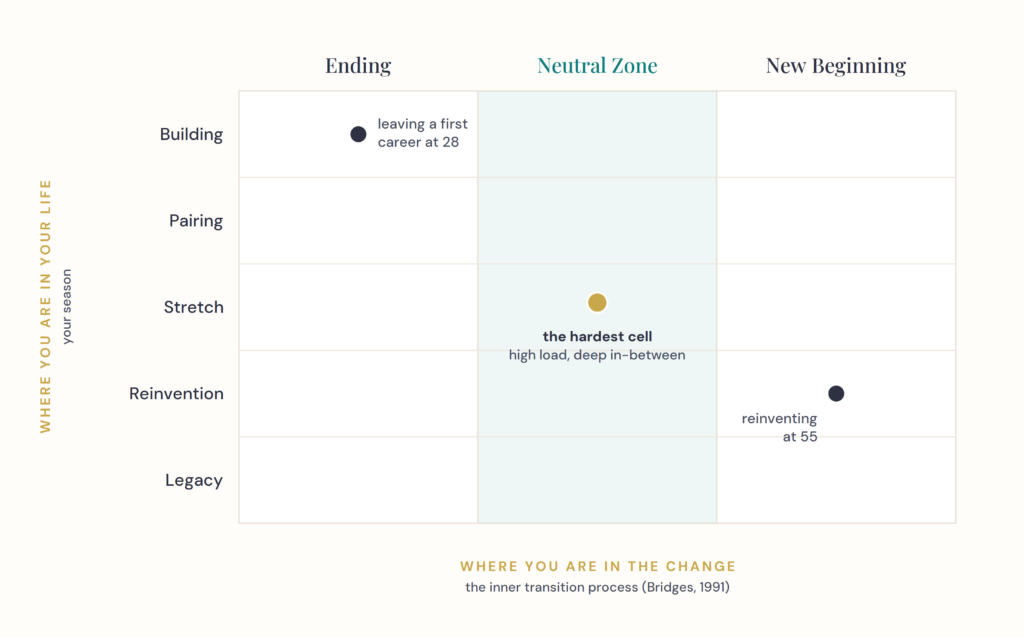
The two-axis model. Every woman sits at an intersection of a season and a stage, and the same season can hold a 28-year-old and a 55-year-old at completely different points in the change. The shaded column is the neutral zone, the in-between that does the quiet work of every transition.
Why it lands harder on us
Now the part that explains why this can feel so much heavier than the tidy story allows. For women, the two collide.
The neutral zone – Bridges’ messy middle – is uncomfortable for anyone. But it tends to arrive in precisely the season researchers found to be the most demanding of all: the years thick with caregiving, competing roles, and a full job pressing on a fuller life (O’Neil & Bilimoria, 2005).
Maternity leave is an ending. Coming back is a neutral zone. Becoming, in the same breath, the professional and the mother is a new beginning, and these often happen inside the same eighteen months, while you are also exhausted and the stakes feel enormous.
So no, the messy middle is not harder for you because you are less resilient. It is harder because it arrives with the volume turned all the way up: more riding on it, and less room to sit in the not-knowing.
Naming that is not an excuse. It is the beginning of strategy; the difference between fighting yourself and finally fighting for yourself.
The Five Seasons
So here they are. Not age brackets; postures. You will likely know yours the moment you read it, and you may well be living in two at once.
1. Building.
You’re laying a foundation and proving what you can do. The ache is the pull between exploring widely and the pressure to look settled before you are.
2. Pairing.
Your career and a shared life are intertwined. The work is holding your own ambition steady alongside someone else’s, and not quietly filing yours second.
3. Stretch.
You’re trying to grow with almost no spare time or bandwidth; young children, caregiving, a full job inside a fuller life. The tension is wanting more and seeing nowhere to put it.
4. Reinvention.
The track record is real, and the question underneath is, is this still it? You’re deciding whether to reinvent, and whether the identity you built can come with you.
5. Legacy.
The focus turns to what you leave behind: who you bring up, what you contribute, what’s yours to carry and what you’re finally allowed to set down.
You’re not meant to live in one of these forever, and you are not failing if two are true at once. A married woman of twenty-eight can be in Building and Pairing together. A single woman of fifty can be deep in Reinvention.
The seasons don’t run in a straight line because women’s lives never have, and the research that first tried to pin them to fixed ages eventually conceded as much (O’Neil & Bilimoria, 2005; Wittenberg-Cox, 2016).
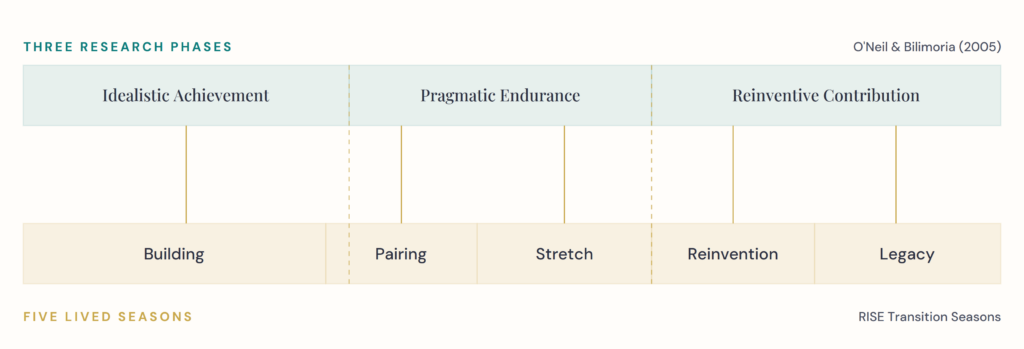
From three research phases to five lived seasons. Pairing is split from the front of the relational years; Reinvention and Legacy divide the third phase, keeping the scholarship, but giving it the resolution a real life needs.
Most “stuck” was never stuck
And this is the relief I most want to hand you. So much of what we call being stuck is not stuck at all. It is being mid-season, or sitting in the neutral zone, mistaking a stage for a sentence. The plateau that feels like failure is usually just the in-between doing its slow, unglamorous, necessary work (Bridges, 1991). It is not a sign you chose wrong. It is the part of every real change that has no view yet.
Naming your season doesn’t make the work easy. But it makes it legible. It tells you whether you need clarity or capacity, a bold move or a held position, an ending grieved or a beginning protected. It swaps the cruel question – what is wrong with me? – for a far kinder and more useful one: oh. This is where I am.
A map for where you’re standing
That is the whole reason I built the thing I’m sharing today. Transition Seasons is a short, tap-through diagnostic – two or three minutes, no long forms – that places you on both axes at once: your primary and secondary season, and where you sit in the change itself. It walks you through the full RISE Method™ and gives you a clear read on what your season is actually asking of you, and the one move that fits it.
It won’t tell you what to do with your life. It will tell you, with some precision, where you’re standing, which is the thing every good decision quietly waits on, and the thing almost no advice bothers to find out first.
Take it when you have a quiet few minutes to yourself. And if you’re willing, write back and tell me the season you landed in, and whether it was the one you expected. I read every reply; the truth is your answers are quietly shaping something larger I’ll be ready to share before the year is out.
You are not behind. You are not ungrateful. You are in a season – and now you have the map.
References
Bridges, W. (1991). Managing Transitions: Making the Most of Change. Addison-Wesley.
Levinson, D. J. (1978). The Seasons of a Man’s Life. Knopf.
Mainiero, L. A., & Sullivan, S. E. (2005). Kaleidoscope careers: An alternate explanation for the “opt-out” revolution. Academy of Management Executive, 19(1), 106-123.
O’Neil, D. A., & Bilimoria, D. (2005). Women’s career development phases: Idealism, endurance, and reinvention. Career Development International, 10(3), 168-189. https://doi.org/10.1108/13620430510598300
Super, D. E. (1980). A life-span, life-space approach to career development. Journal of Vocational Behavior, 16(3), 282-298.
Wittenberg-Cox, A. (2016). Four Phases of Women’s Careers. 20-First Publishers.
Step Inside RISE™
Career transitions rarely fail for lack of effort. They stall when one thing is missing. Inside RISE is built on the C.A.R.E. Framework™ — the four domains that decide whether your transition succeeds by design, or stalls by default:
Clarity — name exactly who you're becoming, so the search stops feeling scattered.
Architecture — the habits, learning, and routines that hold the change up.
Resources — the energy, wellbeing, and relationships to sustain the climb.
Execution — turn the plan into visible, weekly progress instead of good intentions.
Your diagnostics, the RISE Report, the C.A.R.E. Assessment, and the 90-Day Transition Runway — all in one place. Free, and yours to keep.
Where is your career transition stalling?
Are you struggling to map your next career move, or are you having trouble identifying the right executive advocates to back your transition?
Click here to email me directly and share your context; I read and respond to every message personally.