
You did the brave thing. You left, or switched, or started. There was a date on a contract, an announcement, a flurry of congratulations.
And then, months later, you notice something nobody prepared you for. You are still explaining the old place. Still measuring the new one against it. Still, in some quiet way, waiting to feel like yourself in it, as though part of you moved offices but is somehow still standing in the doorway of the place you left.
You don’t say this out loud either. On paper you’ve arrived, so the question stays private and a little disloyal: did I actually arrive here, or did I just relocate?
If you’ve read The Slump That Isn’t a Slump, you learned to read the signal that something needed to change. If you’ve taken Transition Seasons, you found your season and crossed the disorienting middle. This issue is about the part almost no one maps: what happens after the leap, and how you’ll know it has finished.
We’re measuring it with the wrong clock
The world marks a transition complete on the day it begins. New title, new salary, the post that gets two hundred likes. These are what researchers call other-referent markers of career success: the things other people can see and count. They are real, and they matter. They are also nearly useless for telling you whether you’ve arrived.
Because alongside that ledger sits a second one, self-referent success, and this is where arrival actually lives. Not in the salary but in whether the work is aligned with goals that are genuinely yours. Not in the promotion but in whether the work itself interests you, whether you have real autonomy over how you do it, whether it lets you express what you value, whether it sits inside a life that fits, whether you are still learning.
When people are asked to judge their own careers, it is these internal measures that dominate; the external ones barely feature (Heslin, 2005; Arthur, Khapova & Wilderom, 2005). So if you’ve been holding up the visible ledger to decide whether you’ve arrived, no wonder the reading keeps coming back wrong. You’re using the wrong instrument.

Two ledgers for one transition. The world marks the move done on your start date. But the signs that you have actually arrived are self-referent – quieter, internal, and almost invisible from the outside. The clearest of them is simply that the place you left has stopped being the thing you measure everything against.
It moves like grief, even when you chose it
The reason arrival lags so far behind the start date is that a transition, even a wanted one, is a loss. And loss has a shape whether you schedule it or not. The classic map of it runs in four movements (Bowlby, 1980).
First a kind of shock, a numbness where it hasn’t quite registered: what just happened to me? Then yearning, where you miss the old place, sometimes idealise it, and quietly worry how they’ll manage without you. Then the hard stretch, disorientation, the part that feels like proof you made a mistake: who am I now, and what am I doing? And finally re-organisation, where the picture settles, and the energy comes back: I’m not who I was, I have options, I’m ready to begin.
You do not fail your way through the third movement. You grieve through it. That disorientation is the same neutral zone Transition Seasons maps, the in-between that does the quiet work of every change (Bridges, 1991). Reorganisation is the far shore. It is arrival. And it is precisely the part the celebratory version of career change leaves out, which is why so many capable women reach the messy middle and conclude the problem is them.
What arrival actually looks like
So if the title can’t tell you, what can? The single marker I’d put above all the others is almost embarrassingly simple: you’ll know the loss has been assimilated when the old place is no longer the thing you measure everything against, when less than a tenth of your conversation still circles back to it. Not because you’ve forgotten it. Because it has stopped being your centre of gravity.
Underneath that headline sit the quieter signs. Read them as a mirror, not a checklist to grade yourself against, because not one of them can be handed to you from the outside.
Your worth has come unhooked from your title. You can describe who you are without reaching for what you do for a living.
The new routine feels like yours. The day stops feeling like a costume you put on each morning and starts feeling like your own clothes.
You’ve stopped rehearsing the past. The old place drops out of your sentences; a week goes by and it simply doesn’t come up.
You’re facing forward. You can say, without flinching, where you want to be in a year, in three years, in five years.
You’ve built a real network where you are. Relationships in every direction, above and below your level, not just the contacts you brought with you.
You’re seen as credible. People bring you things. You have visibility, and you understand what’s actually expected of you here.
The enthusiasm is steady, not frantic. You’re not running on fumes or overcompensating to prove you belong. You’re not going overboard. You’re just here.
You will not tick all of these at once, and you are not behind if you tick only two. They arrive at their own pace, which is the next thing worth understanding.
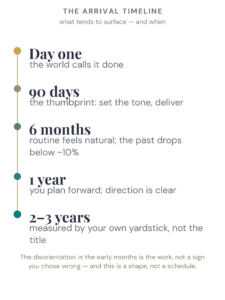
The arrival timeline. The visible milestones land on day one. The ones that tell you you have actually arrived surface slowly, over months and years. Arrival runs late, reliably, and that lateness is not a failure of nerve.
The arrival timeline
The early stretch carries more weight than its length suggests. The first ninety days function as a kind of thumbprint: the tenor you set in them, the relationships you build in every direction, the first tangible thing you deliver, tend to shape how the whole tenure goes (Watkins, 2003). This is the season to learn the unwritten rules and produce something real, not to wait until you feel ready.
By around six months, the routine stops feeling borrowed and the old place starts dropping out of your sentences. Near the one-year mark, you can plan forward with some confidence and articulate where you’re heading. By two or three years, you measure the whole thing by your own criteria rather than the title on your email signature.
The exact numbers vary by person and by the size of the change. What holds is the shape: the visible markers land on day one, and the ones that matter surface slowly. When I left corporate in 2025, my start date as my own boss and the day I actually felt like her were many months apart. That gap is not a defect. It is how arrival works.
You’re a palimpsest, not a whiteboard
Now the part that takes the most weight off, because it quietly undoes the thing that keeps people stuck on the threshold: the belief that to arrive, you must first become someone new.
You don’t. Career identity is both stable and moving at once, and the ongoing work of holding those together has a name: career identifying (Ibarra & Barbulescu, 2010). You keep a thread stable enough to make coherent choices while you adapt the rest. Which means you are a palimpsest, not a whiteboard: the new self is written over the old one, the earlier marks still show through, and they still inform the work.
The woman who was a teacher does not stop being a mentor, a communicator, a translator of difficult ideas. Those are her lingering identities, and she carries them across. Herminia Ibarra put it most precisely: the deepest change is not a career transition; it’s closing the gap between who you are and what you do (Ibarra, 2003).
This is also where Reputation Anchoring, the blind spot of tethering your worth to a title and the recognition it carried, finally loosens its grip. Some things cross over with you and some stay behind, and naming which is which is most of the work. What crosses: your skills, your values, your relationships, your identity strengths, the way you read a room and make a call. What stays: the job title, the accolades, the role’s specific duties, and the old decision rules you’ve outgrown.
Old identities cling because they’re anchored in your daily acts, your relationships, and the stories you tell about yourself; they loosen only once you start doing new things and retelling the story through new possibilities (Ebaugh, 1988).
Grief, limbo, reconstruction
The identity shift moves through three phases, and each one has a question that does the work. Sit with them in order. They carry you from honouring what you’ve lost to deciding what comes with you.
Grief. What do I genuinely miss about the old role? And who did I get to be when I was in it?
Limbo. Which parts of that identity still feel true for me now, independent of where I work?
Reconstruction. What do I want this next chapter to mean, to me and to others? And what, outside work entirely, helps me feel valued?
The first two honour what you’re losing and surface what still holds true; the last hands you back the authorship. You are not waiting to discover who you’ve become; you are choosing what to carry into it.
Closure is something you make, not something you’re given
If arrival is self-referent, then so is closure. It does not get conferred by an exit interview or a farewell lunch. You create it, deliberately, and a few moves do most of the work.
- Honour what it gave you. Write down, plainly, what you built and what you learned in the chapter you’re closing. Keep a record of the wins, the kind words, the things that went right. You do not erase achievements by ending a chapter; you keep them by naming them. Put the list where you’ll see it on the days the new role makes you feel like a beginner again.
- Choose ritual over rumination. Rumination keeps reopening the wound; a small deliberate act closes it. A letter to the old role that you never send. A single line each morning for a week. A quiet ceremony of your own design. A physical gesture reinforces the ending that the mind keeps trying to re-litigate.
- Draw the boundary. Closure needs edges: new routines, a different workspace, a little distance to process without reaching back. For the things genuinely left unfinished, set a real plan so they stop nagging, then let the rest go.
- Release without reopening. Clean closure is brief, clear, and definitive: you speak the truth once, without blame, and you don’t go back to renegotiate the old meaning. Most of the pain of endings comes not from the ending itself but from endings handled poorly, dragged out, half-finished, left tangled in silence.
And the first move, the one that precedes all the others, is the quiet, honest admission to yourself that it’s time. You won’t always get a clean signal from the outside. You give yourself the closure, and then you walk forward without reopening the door.
Applied this issue — The RISE Method™ · Elevate
Recognise names the signal. Interpret and Strategise draw the map. Elevate is the part almost no one coaches: not negotiating your offer, but negotiating your arrival — crossing into the new role, season, or life so fully that it stops being somewhere you went and becomes somewhere you are.
So you’ll know you’ve arrived not from the signature line on your email, but from a quieter thing: the morning you notice the old place has gone quiet. Not gone. Just no longer the centre of the map. You didn’t reinvent yourself to get here. You carried yourself across. That is the whole of Elevate, and it is the part worth crossing over for.
Here’s to knowing where you stand, and when you’ve arrived.
References
- Arthur, M. B., Khapova, S. N., & Wilderom, C. P. M. (2005). Career success in a boundaryless career world. Journal of Organizational Behavior, 26(2), 177-202.
- Bowlby, J. (1980). Attachment and Loss, Vol. 3: Loss — Sadness and Depression. Basic Books.
- Bridges, W. (1991). Managing Transitions: Making the Most of Change. Addison-Wesley.
- Ebaugh, H. R. F. (1988). Becoming an Ex: The Process of Role Exit. University of Chicago Press.
- Heslin, P. A. (2005). Conceptualizing and evaluating career success. Journal of Organizational Behavior, 26(2), 113-136.
- Ibarra, H. (2003). Working Identity: Unconventional Strategies for Reinventing Your Career. Harvard Business School Press.
- Ibarra, H., & Barbulescu, R. (2010). Identity as narrative: Prevalence, effectiveness, and consequences of narrative identity work in macro work role transitions. Academy of Management Review, 35(1), 135-154.
- Watkins, M. D. (2003). The First 90 Days. Harvard Business Review Press.
Step Inside RISE™
Career transitions rarely fail for lack of effort. They stall when one thing is missing. Inside RISE is built on the C.A.R.E. Framework™ — the four domains that decide whether your transition succeeds by design, or stalls by default:
Clarity — name exactly who you're becoming, so the search stops feeling scattered.
Architecture — the habits, learning, and routines that hold the change up.
Resources — the energy, wellbeing, and relationships to sustain the climb.
Execution — turn the plan into visible, weekly progress instead of good intentions.
Your diagnostics, the RISE Report, the C.A.R.E. Assessment, and the 90-Day Transition Runway — all in one place. Free, and yours to keep.
Where is your career transition stalling?
Are you struggling to map your next career move, or are you having trouble identifying the right executive advocates to back your transition?
Click here to email me directly and share your context; I read and respond to every message personally.