
Every job description asks the same quiet question: will you fit in here? It is the wrong question, and answering it too well is one of the most expensive things you can do in a career transition.
Because fitting in and belonging are not the same thing. Fitting in is changing yourself until a place will have you. Belonging is being accepted as you already are. One costs you effort. The other costs you the very self you were trying to advance.
Most workplaces don’t ask you to belong. They ask you to fit, and “fit” is rarely neutral. The cost of fitting in is real for anyone in transition, and it is sharpest for those whose difference the room can see. Studies of ethnic-minority professionals keep surfacing the same quiet arithmetic: more than half say they feel obliged to change something about themselves to be accepted: the accent, the hair, how and what they eat at their own desk. Many report working measurably harder than their peers simply to be read as equal. That cost is paid in confidence, and it is not paid equally.
In any transition- a new sector, a bigger role, a different kind of company- “cultural fit” can quietly mean: be excellent, but be a little less of yourself while you do it. Straighten this. Soften that. Laugh at the right things. It lands hardest on anyone whose full self doesn’t match the room’s defaults, but almost everyone in transition feels a version of it. And here is the trap: the harder you work to fit a place that was never built with you in mind, the more you confirm, to yourself, that you don’t belong. That is how imposter syndrome is manufactured; not by your inadequacy, but by a room’s narrow definition of “professional.”
Fitting in is changing yourself until a place will have you. Belonging is being accepted as you are.
So the more useful question is not “will they take me?” It is “can I belong here without disappearing?” And you can answer a surprising amount of that before you ever accept, if you treat the interview as what it actually is: not an audition you are failing, but reconnaissance you are conducting.
How a culture tells the truth before you join
A culture cannot fully hide from a candidate who is paying attention. Here is where to look.
Watch how they treat you now. A culture reveals itself in how it handles you as a candidate, when you are at your most courted. Repeated last-minute cancellations, being left waiting with no apology, an interviewer glancing at their phone while you speak: that is not a busy week. That is how they treat someone they are trying to win.
The tell. How an organisation treats you as a candidate is the most honest preview you will get of how it treats its people. Believe the preview.
Ask the questions that can’t be faked. Values live in decisions, not on walls. So don’t ask what the values are; ask for a decision they shaped.
Ask. “Tell me about a time your values guided a genuinely hard call.” A real culture answers with a specific story and names actual people; a performative one reaches for the mission statement and pauses.
Then ask. “What happens here when someone makes a mistake?” The answer tells you at once whether you will be led — or managed by fear.
Read the exits. How long do people actually stay? A few minutes on LinkedIn will tell you, and the honest question does the rest.
Ask. “Why is this role open?” Resignation is a very different story from growth. And “how many people are you considering?” — a long list is often turnover wearing the costume of expansion.
Distrust the too-perfect answer. Some phrases are built to sound like culture while saying nothing. “Work hard, play hard” often means no boundaries. “We’re like a family here” can mean guilt is a management tool. And an interview where everything gleams and nothing is ever hard isn’t a healthy culture; it’s a rehearsed one.
Watch for. The healthiest leaders don’t have perfect answers. They tell you what they’re still figuring out, name real people who grew there, and speak candidly about what’s hard. Polish is not the same as truth.
Trust the feeling in the room. The signal we are so often taught to override — the vague unease, the energy that is slightly off — is data. Survey after survey finds that people who took a role despite a bad feeling in the interview turn out to have been right.
Remember. Your intuition is not being dramatic. It is reading what the brochure will not say. If a room already feels like it needs a smaller version of you, believe it the first time.
Underneath all of it, you are screening for one thing: whether the story they tell matches the story their people live. Performative culture — values as marketing, inclusion as a slogan with nothing behind it — is worse than no stated culture at all, because it makes you doubt yourself for noticing the gap. Real culture shows up where no one is performing for a candidate: in who gets promoted, in how disagreement is handled, in whether anyone with caring responsibilities ever actually leaves on time.
Performative culture is worse than no culture at all. It makes you doubt yourself for noticing the gap.
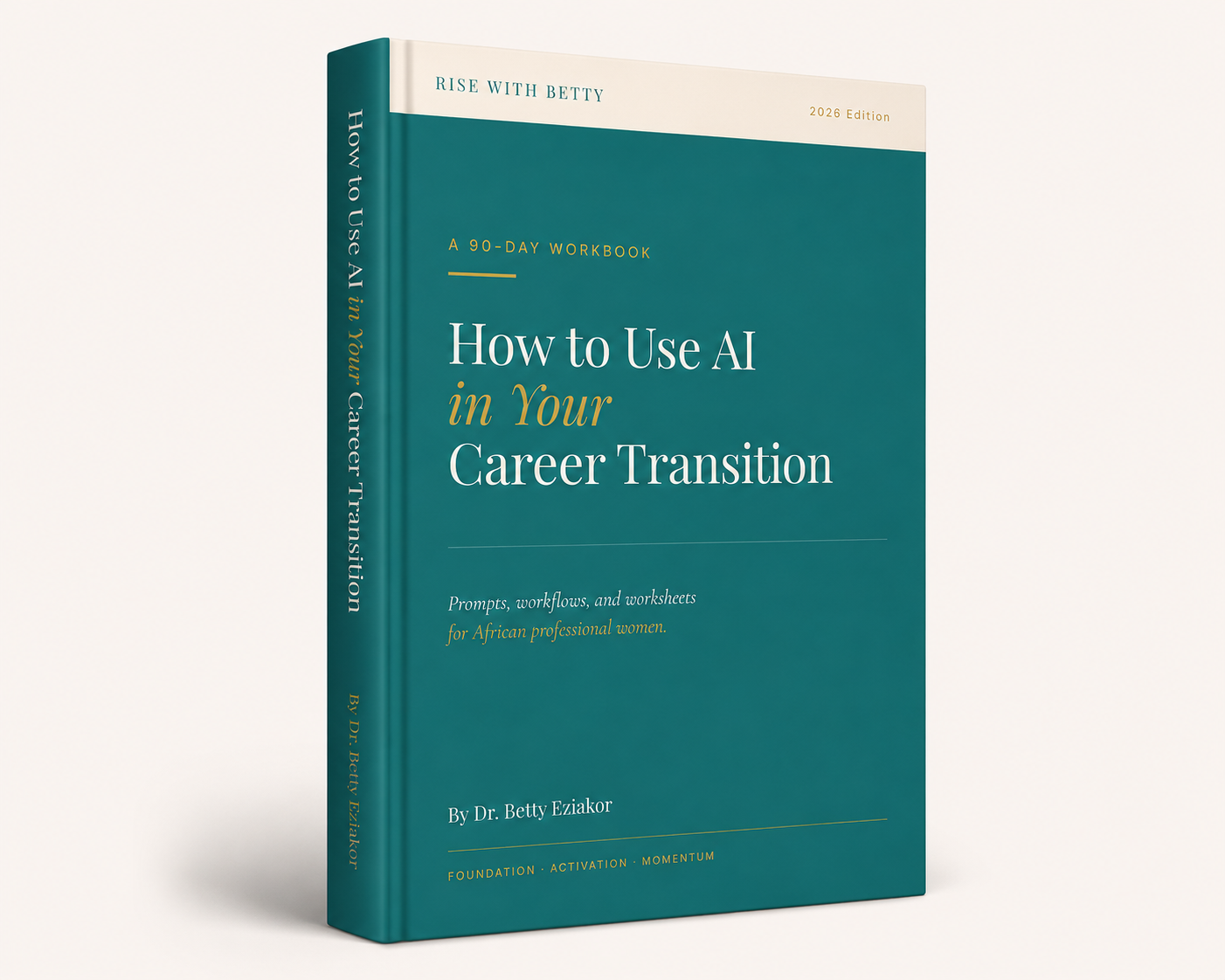
How To Use AI in Your Career Transition
AI can write your emails. It can build your slides in seconds. But can it move your career forward? In the right hands — yes. That's exactly what The RISE AI Transition Workbook is built to do. It's a 90-day, fillable toolkit and prompt library that turns AI into your personal transition strategist, walking you, step by step, from foundation to momentum.
Get Your Copy →When fitting in becomes shrinking
There is a point where adapting tips into erasing, and it is worth knowing the line. Adjusting your register for a room is ordinary; everyone does it, and it costs nothing. But when you find yourself changing the things that are load-bearing to who you are- how your name is said, your hair, your faith, the way you actually think- simply to stay acceptable, that is no longer adaptation. That is a standing instruction to disappear, and it drains the exact energy your new role needs.
Code-switch as a tool if you choose. Never as a permanent condition. The moment it starts to cost you your core, the room is the problem, not you.
Here is what to carry into your next transition. Belonging is not a soft perk you are lucky to stumble on. It is a performance variable. You do your best work in the rooms where you are not spending half your energy translating and shrinking. A place that needs your full self will let you bring it. A place that needs you smaller is not a fit you failed; it is a mismatch you dodged.
You are allowed to screen for that. You are allowed to want to belong, not merely to fit. And if a room keeps asking you to disappear to stay in it, remember, you can move.
You are not a tree.
Reading a culture before you commit is a skill, not a vibe; and it’s one you can practise. The free CultureCode Fit™ diagnostic is where to start: it shows you the culture you genuinely thrive in, and gives you a way to test any room against it before you say yes.
Take the free CultureCode Fit™ →Step Inside RISE™
Career transitions rarely fail for lack of effort. They stall when one thing is missing. Inside RISE is built on the C.A.R.E. Framework™ — the four domains that decide whether your transition succeeds by design, or stalls by default:
Clarity — name exactly who you're becoming, so the search stops feeling scattered.
Architecture — the habits, learning, and routines that hold the change up.
Resources — the energy, wellbeing, and relationships to sustain the climb.
Execution — turn the plan into visible, weekly progress instead of good intentions.
Your diagnostics, the RISE Report, the C.A.R.E. Assessment, and the 90-Day Transition Runway — all in one place. Free, and yours to keep.
Where is your career transition stalling?
Are you struggling to map your next career move, or are you having trouble identifying the right executive advocates to back your transition?
Click here to email me directly and share your context; I read and respond to every message personally.