For decades, career advice followed a predictable, hyper-specialized narrative: Pick one niche, become a world-class expert, and climb a linear corporate ladder.
But in an era accelerated by automation, artificial intelligence, and shifting economic landscapes, hyper-specialization has transformed from a shield into a vulnerability.
If your entire professional identity is anchored to a single technical tool or a highly specific industry framework, you are one software update away from obsolescence.
The Concept of Skill Stacking
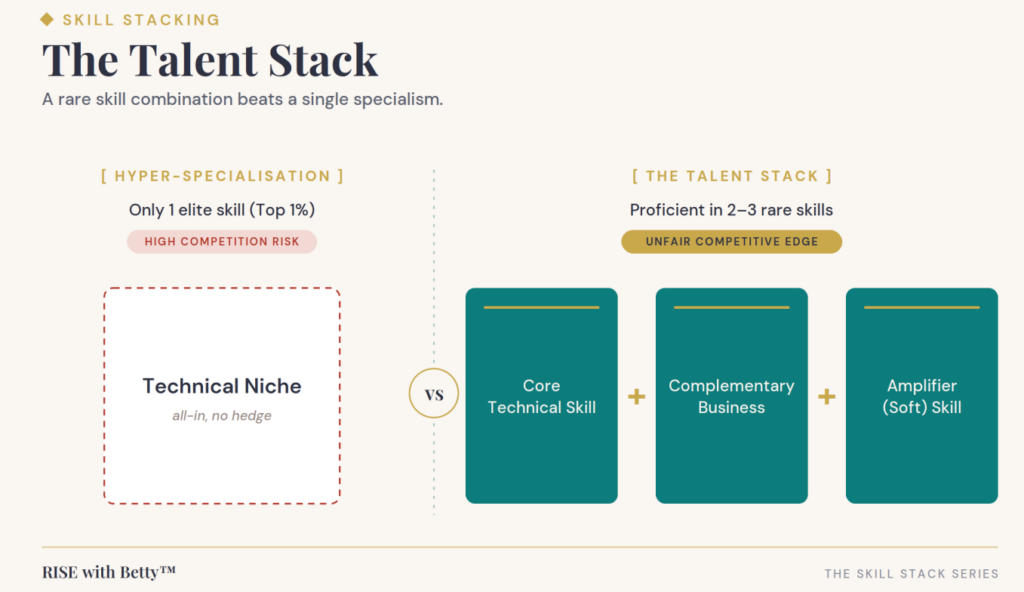
The premise is mathematically liberating: Instead of spending 10,000 hours trying to become the top 1% globally at a single discipline (an elite tier with brutal competition), you aim to get into the top 20% in two or three complementary fields that rarely cross paths.
When you layer these distinct proficiencies on top of one another, you form a highly differentiated professional identity. You stop competing on price or credentials because you have effectively built a “monopoly of one.”
You become the unique bridge between siloed departments, making career pivots smoother, less risky, and significantly more lucrative.
THE BENEFITS FRAMEWORK
Why Skill Stacking Dictates Modern Career Transitions
When navigating a professional pivot, relying on a singular expertise forces you to compete against established incumbents on their home turf. Skill stacking fundamentally alters this dynamic through five core structural advantages:
| Benefit | How It Helps |
| Highlights Transferable Skills | Demonstrates deep adaptability, validating that you can perform across volatile environments and making career pivots smoother. |
| Starts From What You Have | Builds on your existing foundation instead of treating past experience as wasted equity to be thrown away. |
| Eases Professional Pivots | Merging a functional technical core with deep business knowledge constructs a natural, low-risk bridge into a new industry. |
| Commands Higher Compensation | Justifies premium salaries and pay bumps by positioning you to solve broader, cross-departmental problems that single-discipline experts cannot see. |
| Opens Unique Roles | Creates exclusive access to hybrid, strategic roles that traditional single-discipline paths rarely reach. |
For women, particularly mid-career professionals, skill stacking offers an immense structural advantage. Whether returning from a career hiatus, changing industries, or aspiring to executive leadership, stacking prevents you from having to start back at the bottom of the corporate ladder.
The Architecture
How to Map and Layer a High-Value Skill Stack
A robust skill stack isn’t a random collection of items on a resume; it is a deliberate cross-pollination of disciplines. Think of it as a three-tiered structural pyramid designed to maximize your market premium and career resilience.
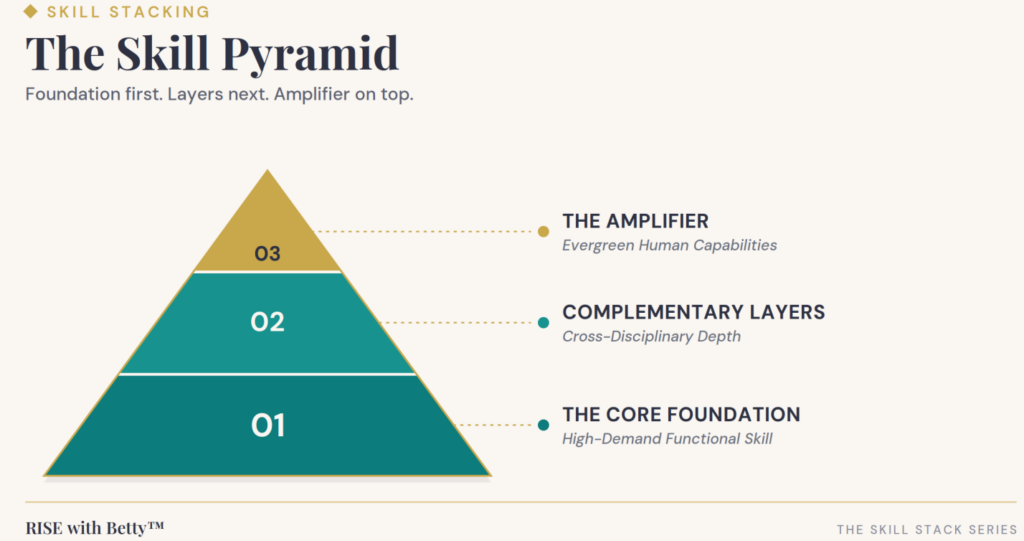
Layer 01: The Core Foundation (The “What You Do”)
This is your anchor capability. It aligns closely with strong market demand and forms the baseline of your day-to-day functional output.
- Examples: Data Analysis, Software Engineering, UX/UI Design, Product/Project Management, Human Resources.
Layer 02: Complementary Layers (The “How You Scale It”)
These are adjacent technical or business skills that multiply the impact of your core. They allow you to understand the broader ecosystem of a company, enabling you to speak the languages of different departments.
- Examples: A Software Engineer adding Cloud Architecture + Product Sense; a Marketer adding SQL for Analytics + Conversion Copywriting
Layer 03: The Amplifier (The “How You Lead”)
These are durable, evergreen human capabilities that AI and automation cannot easily replicate. They act as a force multiplier, translating your raw technical output into leadership authority and organizational influence.
- Examples: Strategic Storytelling, Emotional Intelligence, Cross-Cultural Collaboration, Complex Problem-Solving.
PROVEN TRANSITION PATHWAYS
Real-World Case Studies of Unique Stacks in Action
To understand how skill stacking works in practice, look at how professionals with traditional, non-technical backgrounds are successfully retrofitting their expertise for emerging industries without starting from zero.
1. Corporate Lawyer → Tech Business Development (Carta)
- The Core: Legal precision, contract analysis, and regulatory navigation.
- The Complementary Layer: Business development frameworks and ecosystem networking.
- The Amplifier: Deep understanding of equity and ownership infrastructure.
- The Transition: Flora Tsui leveraged 9 years in corporate law on Wall Street to pivot into tech business development at Carta, building high-value fintech partnerships rather than just advising from the outside.
2. Corporate Lawyer → Scrum Master & Agile Delivery Manager
- The Core: Legal reasoning, risk modeling, and meticulous critical thinking.
- The Complementary Layer: Scrum Master certification and Agile delivery methodologies.
- The Amplifier: Expert cross-functional coaching.
- The Transition: Clara Rufai transformed her traditional legal training into tech leadership, guiding complex digital delivery teams using her native risk-mitigation instincts.
3. Medical Doctor → e-Health Systems Developer
- The Core: Clinical medical expertise and firsthand understanding of healthcare workflows.
- The Complementary Layer: Software engineering and IT system architecture.
- The Amplifier: Healthcare operations optimization.
- The Transition: Dr. Wuleta (Ethiopia) blended her clinical background with IT competencies to design and deploy scalable e-health systems, modernizing operational infrastructure across hospitals nationwide.
4. The Functional Pivots
- Property Manager → Sales Leader: Combined real estate coordination with Marketing Campaigns + Sales Funnels to step into executive sales leadership without restarting her career.
- Graphic Designer → Tech Front-End Developer: Layered HTML/CSS/JavaScript on top of an existing Visual Hierarchy + UX Design foundation, commanding a distinct premium at the intersection of code and aesthetics.
- The Cloud + Cybersecurity Duo: Merging cloud systems architecture with active cybersecurity protocols—a high-demand stack currently netting professionals immediate $10K pay bumps and a median $102K salary premium.
STRATEGIC EXECUTION
The 6-Month Skill-Stacking Framework
Building a talent stack requires a shift from passive, credential-chasing education to an active, system-driven learning methodology. Below is a structured blueprint to identify gaps, upskill efficiently, and market your unique combination.
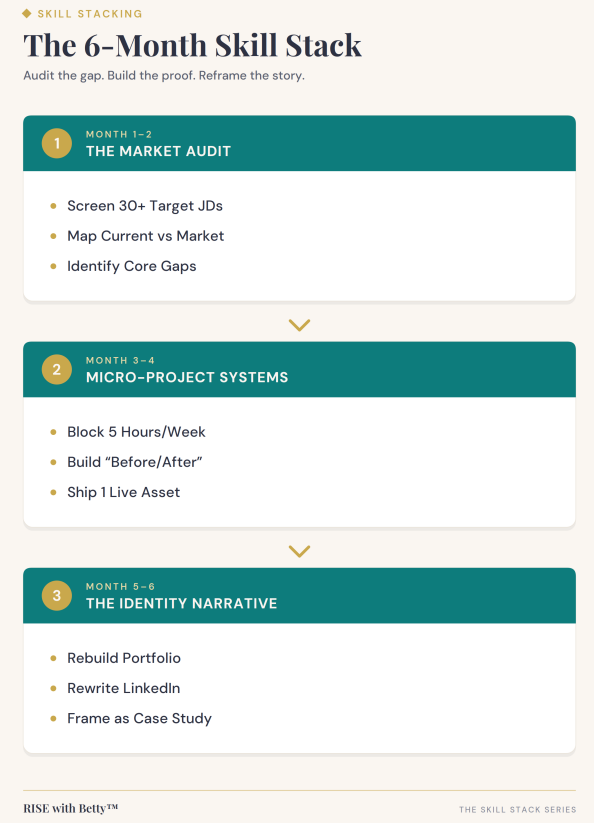
Phase 1: The Market Audit (Months 1–2)
Stop guessing what skills are valuable. Execute a cold, data-backed assessment of your target market:
- Screen Job Descriptions: Find 20 to 30 postings for roles you desire across industries you want to enter.
- Isolate Durable Signals: Highlight recurring technical requirements and methodologies that appear in more than 50% of the postings (e.g., SQL, Agile, Figma). Ignore fleeting buzzwords or specific tool versions that change every two years.
- Construct a Gap Matrix: Rate your current competency from 1 to 5 against the market standard to pinpoint exactly where your stack lacks structural integrity.
Phase 2: Micro-Project Systems (Months 3–4)
Do not wait for a company to give you permission to practice a new skill. Implement the 5-Hour Weekly Rule dedicated entirely to proactive, self-directed execution:
- Build a Living Asset: If you are learning data analytics, do not just finish a course; build an automated dashboard that solves a practical problem (e.g., a tracking template for recruitment metrics or budget efficiencies).
- Document the “Before and After”: Focus your learning entirely on creating portfolio pieces that prove you can deliver measurable outcomes (time saved, revenue influenced, workflow steps optimized).
Phase 3: The Identity Narrative (Months 5–6)
A brilliant skill stack is useless if recruiters view your background as disjointed. You must consciously reframe your narrative from a “scattered resume” into a highly intentional, “problem-solution story.”
- The LinkedIn Pivot: Update your headline to immediately announce the intersection of your skills.
Weak Headline: “Project Manager looking for Tech Roles”
Talent Stack Headline: “Cloud-Secure Architect + AI-Driven Data Engineer” or “Operations Manager + Cloud Fundamentals | Optimizing Complex Tech Workflows”
- The Portfolio Shift: Anchor your applications with a mini-portfolio (a single Notion page, a clean PDF, or a Canva Public Share Link) that showcases 2 to 3 case studies illustrating how your core skill and complementary layers work together to achieve a specific result.
THE LONG GAME
Future-Proofing via Durable Assets
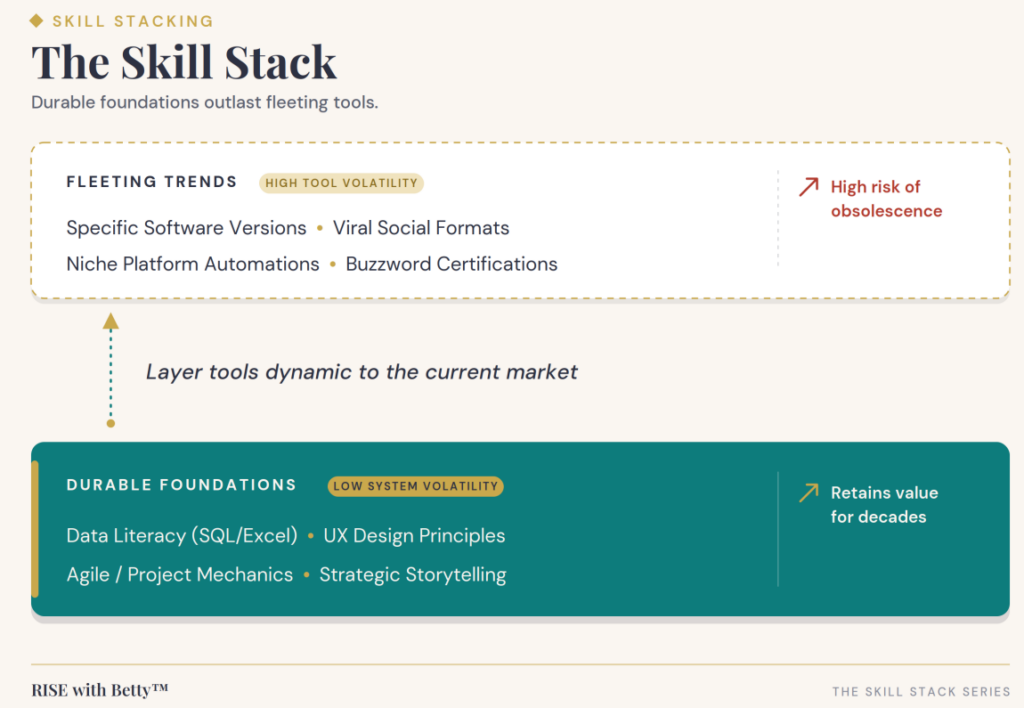
The true beauty of the skill-stacking methodology is its built-in immunity to automation. While individual tools, platforms, and specific code syntaxes will inevitably shift, the fundamental concepts beneath them; data literacy, user-centric design principles, systematic project delivery, and human empathy, remain remarkably stable.
For African women pivoting into tech and leadership, skill stacking is uniquely liberating. It gives you permission to stop hiding your background in HR, education, administration, or operations. Instead, it allows you to aggressively brand those experiences as a foundational asset, layering on top the modern digital toolkits; like data literacy, Agile frameworks, and digital storytelling, that position you not as an entry-level switcher, but as an irreplaceable, multi-dimensional leader.
By prioritizing these durable foundations and stacking them intentionally, you ensure that you don’t just survive the next wave of industrial transformation: you architect it.
Step Inside RISE™
Career transitions rarely fail for lack of effort. They stall when one thing is missing. Inside RISE is built on the C.A.R.E. Framework™ — the four domains that decide whether your transition succeeds by design, or stalls by default:
Clarity — name exactly who you're becoming, so the search stops feeling scattered.
Architecture — the habits, learning, and routines that hold the change up.
Resources — the energy, wellbeing, and relationships to sustain the climb.
Execution — turn the plan into visible, weekly progress instead of good intentions.
Your diagnostics, the RISE Report, the C.A.R.E. Assessment, and the 90-Day Transition Runway — all in one place. Free, and yours to keep.
Where is your career transition stalling?
Are you struggling to map your next career move, or are you having trouble identifying the right executive advocates to back your transition?
Click here to email me directly and share your context; I read and respond to every message personally.